
Retirement
Which investment engine is driving your client’s retirement?
In November’s Irish Broker, Ruairi McDonald discusses how advisers can help clients balance today’s income needs with future growth opportunities.
Preparing financially for a retirement that may last decades
For many clients, retirement is a time for new plans, changing priorities and opportunities to do more of what matters to them. But while life after work can take many different directions, one thing remains constant: the need for savings to support it.
That’s why financial readiness is about more than the size of a pension pot. It’s about building savings, protecting them, and helping to sustain a client throughout retirement. With retirement potentially lasting decades, the investment decisions made at retirement can be just as consequential as those made in the years leading up to it.
The ask is no longer simply how to grow a portfolio. It’s how to balance withdrawals, manage risk and preserve the potential for future growth.
The risk of playing it too safe
It’s understandable that clients become more cautious as retirement approaches. The prospect of losing money feels different when there’s no longer a regular salary coming in to replace it. But being overly cautious with savings can introduce risks of its own.
Inflation can gradually erode purchasing power. Concentration risk can leave investment outcomes increasingly dependent on a relatively small number of companies or markets. And behavioural risk, particularly decisions made in response to short-term uncertainty, can have lasting consequences.
Crucially, these risks don’t exist in isolation. Reducing exposure to one can increase exposure to another. Consider a client who moves their retirement savings into cash during a period of market uncertainty. They’ve reduced their immediate exposure to market falls, but their money remains vulnerable to inflation. They’ve also introduced another challenge – deciding when to reinvest.
Protecting capital and protecting a client’s retirement aren’t always the same thing. The role of advice is to help clients navigate these trade-offs, recognising that the right balance depends on their circumstances, withdrawal needs, and investment horizon.
The cost of waiting for certainty
One difficulty with moving to cash is that the decision to reinvest rarely feels obvious. Clients may want to wait until markets settle, economic conditions improve or the headlines become more reassuring. The problem is that markets often recover before confidence does.
History provides plenty of examples of uncertainty, from Black Monday, the dot-com crash, the Global Financial Crisis, Covid-19, and more recent geopolitical shocks. Each created genuine concern about what might happen next.
And the potential cost of waiting can be considerable.
An illustrative €100,000 investment in global equities at the beginning of 1999 would have grown to approximately €421,000 by the end of 2024. Missing just the ten best-performing days over that period would have reduced the outcome to around €237,000. Those strongest days can occur close to periods of sharp market falls, making them particularly difficult to predict. Of course, remaining invested doesn’t mean ignoring risk or suggesting every client should have the same market exposure. Liquidity needs, withdrawal requirements, and capacity for loss are all important.
But for retirement savings that may remain invested for many years, time in the market can often matter more than trying to time it.
The power of time
We tend to associate compounding with the years spent saving for retirement when regular contributions and investment growth can help build a retirement fund. But its relevance doesn’t disappear when someone retires.
Investment returns can generate further returns over time. That opportunity continues even when a portfolio begins supporting withdrawals, although the timing and size of those withdrawals can significantly affect the outcome.
A seemingly small difference in annual returns, sustained over many years, can create a substantial difference in the value of the remaining savings. That doesn’t mean pursuing growth at any cost. It means recognising that the investment horizon doesn’t necessarily end when employment does. And time alone doesn’t determine investment outcomes. How a portfolio is constructed is also important.
Looking under the hood of the investment engine
Two funds can have comparable risk ratings and broadly similar allocations to equities and bonds yet deliver very different investment experiences.
The difference lies under the hood in how they're constructed.
Every fund has an investment engine: the underlying philosophy that determines where it invests, how assets are allocated, how diversification is achieved and its investment discipline.
At Standard Life, we don't believe there's a single investment engine that's right for every client. That's why we offer a range of professionally managed solutions built around different investment philosophies.
Three examples illustrate the differences.
Global Index Funds follow a market-capitalisation-weighted approach, where the largest companies and markets generally carry the greatest weight, reflecting their relative size in global markets.
MyFolio Market diversifies across regions and asset classes using long-term assumptions about risk and return, rather than relying solely on market capitalisation to determine portfolio weights.
Dimensional World Allocation uses a factor-based approach, seeking exposure to company characteristics historically associated with differences in expected returns, including size, relative value, and profitability.
Three credible approaches. Different investment philosophies. Different sources of diversification. And the differences aren’t merely theoretical.
Consider Global Index 60, MyFolio Market III, and Dimensional World Allocation 60/40. All three have equity allocations of approximately 60%. Yet beneath those headline figures, their holdings differ considerably. Global Index 60 has exposure to approximately 2,500 equities. MyFolio Market III holds exposure to around 3,800. Dimensional World Allocation 60/40 has exposure to approximately 12,000.
The number of securities alone doesn’t determine how diversified a portfolio is. Weightings, market concentration, and the relationships between holdings also matter. But the comparison illustrates how differently portfolios can be constructed, even when their headline allocations look similar.
These distinctions become particularly relevant when considering US market concentration, the influence of mega-cap companies or how a portfolio might respond when market leadership changes. The allocation tells us the broad shape of a portfolio. It doesn’t tell us everything about what’s driving it.
Different engines, different approaches.
No single investment philosophy will outperform in every market environment. And two portfolios with similar allocations can behave very differently when conditions change.
That’s why, at Standard Life, we offer different multi-asset approaches rather than assuming there’s one right way to invest.
Advisers bring the understanding of their clients – their circumstances, ambitions and what they need their savings to achieve. Our investment solutions bring different ways of putting that money to work.
The investment engine isn’t simply what sits behind a fund. It’s what determines how that fund puts a client’s retirement savings to work, potentially for decades.
To learn more about the investment philosophies behind our investment range, speak to your Business Manager or you can reach the investment team at investmentsolutionsireland@standardlife.ie
id
Related Insights
-
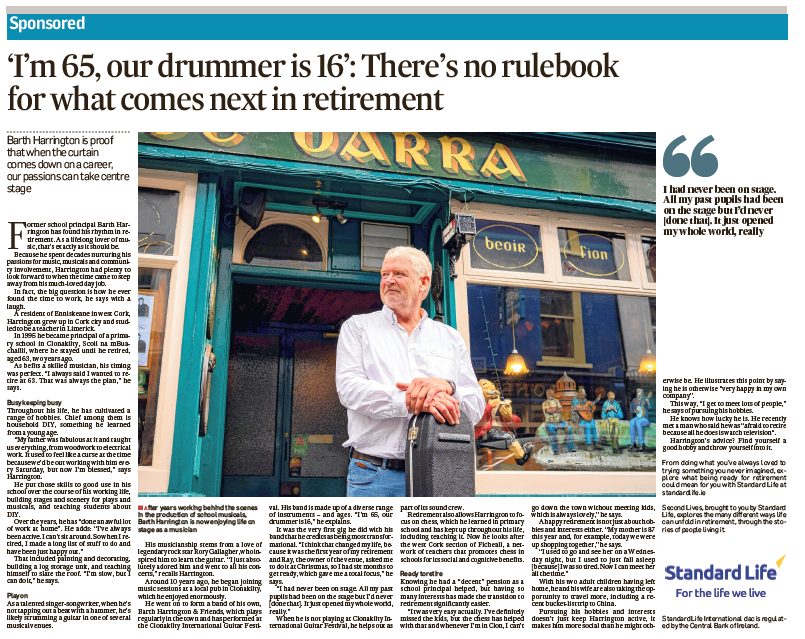
Second Lives, brought to you by Standard Life
Our Second Lives series with The Irish Times shares real retirement stories, which can help you broaden your conversations with clients about what they might want from their lives in retirement. Johanna Coady
November 16, 2026
Read more5 mins read -

Are your clients ready to spend their retirement savings?
Sinead McEvoy discusses how, once employment income stops, clients must turn their pension savings into an income they’re both able and willing to spend. Sinead McEvoy
October 16, 2026
Read more5 mins read -

Why retirement planning is becoming one of advice’s biggest growth opportunities.
In August’s Irish Broker Magazine, Alan McCarthy discusses how retirement is no longer just a pensions conversation. Alan McCarthy
August 18, 2026
Read more5 mins read